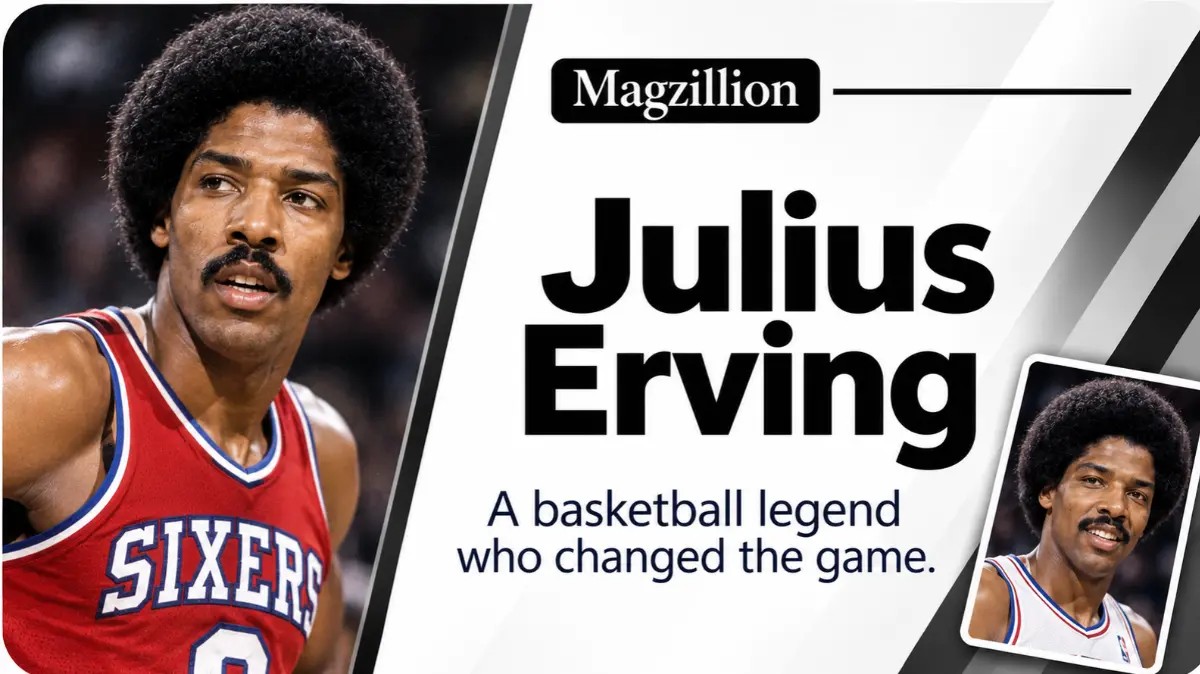
Julius Erving Net Worth: NBA Earnings, Business Ventures, and the Memorabilia Auction
Quick Facts
- Estimated Net Worth: $50 million
- Age: 76 years old
- Date of Birth: February 22, 1950
- Birthplace: East Meadow, Long Island, New York
- Nickname: Dr. J
- Teams: Virginia Squires, New York Nets, Philadelphia 76ers
- Championships: Three, including two ABA titles and one NBA title
- Profession: Former professional basketball player, businessman, and entrepreneur
What Is Julius Erving’s Net Worth?
Julius Erving has an estimated net worth of $50 million in 2026, according to Celebrity Net Worth. Known worldwide as Dr. J, Erving built his wealth through professional basketball, major endorsement agreements, stock investments, business ownership, and brand partnerships. His NBA and ABA salaries were only one part of his financial success. Deals involving Converse, Electronic Arts, Coca-Cola, and Authentic Brands Group helped him create income beyond his playing career. The $50 million figure is a published estimate, not a verified statement of his current assets and liabilities.
Early Life
Julius Winfield Erving II was born on February 22, 1950, in East Meadow, New York. His childhood was not easy. His father left the family when he was young, and his mother worked hard to raise three children. Basketball became an important part of his life, giving him a sense of purpose and an opportunity to build a better future. His talent eventually took him from local playgrounds to college basketball and professional leagues.
Growing Up on Long Island
Erving spent his early childhood in Hempstead before his family moved to Roosevelt, Long Island, when he was around 13. He attended Roosevelt High School, where he became a standout basketball player. His height, athletic ability, and natural scoring skills helped him earn recognition across the region. He also developed the nickname “The Doctor” through a friendship with teammate Leon Saunders. The name eventually became the famous “Dr. J” that basketball fans know today.
College Career at the University of Massachusetts
Erving attended the University of Massachusetts, where he played varsity basketball during the 1969 to 1971 seasons. He made an immediate impact, averaging 26.3 points and 20.2 rebounds per game across his two varsity seasons. He recorded a double-double in 51 of his 52 games and helped UMass win two Yankee Conference titles while making its first two appearances in the National Invitation Tournament.
His college performance established him as one of the most dominant players in the country. Erving left UMass after his junior year to pursue professional basketball opportunities, but he later returned to complete his degree in 1986. His college jersey number 32 was retired, recognizing his lasting contribution to the program.
Professional Career
Erving began his professional career in the American Basketball Association, where his athletic style and scoring ability quickly made him one of the league’s biggest stars. He played for the Virginia Squires and New York Nets before joining the NBA’s Philadelphia 76ers following the ABA and NBA merger. Across 16 professional seasons, he became a champion, league MVP, scoring leader, and one of basketball’s most recognizable figures.
1. Virginia Squires
The Virginia Squires signed Erving in 1971 after he left UMass. His original four year contract was reportedly worth $500,000, a major agreement for a young professional basketball player at the time. He made an immediate impact, earning ABA All-Rookie honors and becoming one of the league’s leading scorers.
Erving played for Virginia from 1971 to 1973. His performances attracted attention from NBA teams, and he briefly attempted to move to the Atlanta Hawks. A legal dispute over his contract prevented the move, and he returned to the Squires before eventually joining the New York Nets.
2. New York Nets
Erving joined the New York Nets in 1973 and became the face of the franchise. He led the team to ABA championships in 1974 and 1976, winning the ABA Finals MVP award on both occasions. He also earned three consecutive ABA MVP awards from 1974 through 1976 and became one of the most popular players in professional basketball.
His success helped raise the profile of the ABA and made him a valuable figure during discussions surrounding the league merger. After the 1975 to 1976 season, the Nets faced financial pressure as they prepared to enter the NBA. Philadelphia eventually acquired Erving’s rights in a major transaction, bringing his ABA career to an end.
3. Philadelphia 76ers
Erving joined the Philadelphia 76ers in 1976 after the team paid approximately $3 million for his rights. He signed a six year contract reportedly worth $3.5 million, making him one of the highest paid players in professional basketball at the time. His arrival gave Philadelphia a major star and helped establish the team as a championship contender.
During his 11 seasons with the 76ers, Erving became an 11 time NBA All Star and won the NBA MVP award in 1981. He also earned multiple All NBA selections and helped the team reach several NBA Finals. His leadership, scoring, and spectacular playing style made him one of the most important players in franchise history.
4. The 1983 NBA Championship
The biggest achievement of Erving’s NBA career came in the 1982 to 1983 season. Playing alongside Moses Malone, Maurice Cheeks, and other talented teammates, he helped Philadelphia dominate the playoffs. The 76ers defeated the Los Angeles Lakers in four games in the NBA Finals, securing the championship.
It was Erving’s first NBA championship and his third professional title when his two ABA championships are included. The victory completed an important chapter in his career and strengthened his reputation as one of the greatest players of his generation.
Playing Style and Iconic Dunks
Erving changed how basketball fans viewed the dunk. Before his rise, many players used dunks mainly as powerful finishes near the basket. Dr. J brought creativity, grace, and dramatic movement to the play. His ability to take off from unusual distances, glide through the air, and finish around defenders made his performances unforgettable.
Some of his most famous moments included his baseline move against the Lakers in the 1980 NBA Finals and his spectacular performances in ABA and NBA All-Star competitions. He was also the 1976 ABA Slam Dunk Contest champion. His style influenced generations of players, including Michael Jordan and many modern high flying forwards.
Career Totals and Honors
Erving finished his professional career with 30,026 combined ABA and NBA regular season points. He also recorded 10,525 rebounds and 5,176 assists across 1,243 games. His scoring average was 24.2 points per game, making him one of the most productive players in professional basketball history.
His major achievements include:
- Three professional championships, including two ABA titles and one NBA title.
- Four league MVP awards, with three in the ABA and one in the NBA.
- Sixteen combined ABA and NBA All Star selections.
- Three ABA scoring titles.
- Two ABA Finals MVP awards.
- Two NBA All Star Game MVP awards.
- Induction into the Naismith Memorial Basketball Hall of Fame in 1993.
- Selection to the NBA 75th Anniversary Team.
Julius Erving’s ABA and NBA Salary and Career Earnings
Erving played during an era when professional basketball salaries were considerably lower than the contracts signed by today’s stars. However, he was among the highest paid players of his generation. His Virginia contract, the major agreement with Philadelphia, and later salary increases gave him a strong financial foundation.
| League and team | Period | Contract or reported salary |
| ABA, Virginia Squires | 1971 | Four year contract worth $500,000 |
| ABA, New York Nets | 1973 to 1976 | Contract details not consistently reported |
| NBA, Philadelphia 76ers | 1976 | Six year contract worth $3.5 million |
| NBA, Philadelphia 76ers | 1980 onward | Annual salary increased from about $600,000 to nearly $1 million |
| NBA, Philadelphia 76ers | Final seasons | Reportedly about $1.5 million per season |
The figures above describe reported contract values and salary levels, not a complete annual earnings record. Contract values can include bonuses and payments spread over several seasons, so they should not be added together as if every dollar represented a separate payment. Available salary databases do not provide a complete and consistent record of Erving’s ABA and NBA income. His business investments and endorsements also make his overall wealth much larger than his playing salary alone would suggest.
Endorsements and Business Ventures: How Dr. J Built Wealth Beyond Basketball
Erving was among the early professional athletes who understood the value of building a business identity beyond sports. Instead of depending entirely on basketball salaries, he used his popularity to secure endorsement agreements and invest in companies. His business interests included footwear, video games, broadcasting, and beverage operations. These opportunities helped him develop financial resources that continued to matter after retirement.
1. The Converse Endorsement
One of Erving’s most important early commercial relationships was with Converse. His original endorsement agreement was reportedly worth $20,000, a significant deal for a basketball player at the time. Converse connected his image with its basketball footwear and helped establish him as a recognizable figure outside the court.
Erving also served on the company’s board of directors. His relationship with the brand demonstrated how an athlete could become more than an advertising personality by taking part in business decisions and long term brand development.
2. Electronic Arts Stock
One of Erving’s most interesting investments involved Electronic Arts. In 1983, he and Larry Bird appeared in the basketball video game One on One: Dr. J vs. Larry Bird. As part of his agreement, Erving received the option to purchase 20,000 shares of Electronic Arts stock for $1 per share.
He exercised the option and held onto the shares as the video game company grew into a major entertainment business. Reports have described the investment as eventually becoming worth millions of dollars. It is an example of Erving accepting an ownership opportunity rather than limiting his compensation to a traditional endorsement fee.
3. Coca-Cola Bottling and Other Ventures
Erving also invested in the Philadelphia Coca Cola Bottling Company. In 1985, he joined businessman J. Bruce Llewellyn and other investors in acquiring majority control of the operation. The investment gave him a stake in a substantial business outside professional sports. He remained associated with the bottling company for more than two decades.
His other business interests included cable television operations in New York and New Jersey, broadcasting, and corporate positions. He also became involved with Anthem Media Group as a shareholder and brand ambassador. These ventures reflect his long standing interest in spreading his investments across different industries rather than depending on a single source of income.
4. The Authentic Brands Group Deal
In 2016, Erving sold a majority interest in the rights to his name, image, and related intellectual property to Authentic Brands Group. The agreement gave the company an opportunity to develop and expand the Dr. J brand through licensing, merchandise, promotional appearances, and partnerships. Reports said the deal included an upfront guarantee and royalties, although its financial terms were not publicly disclosed.
The partnership later became the subject of a legal dispute. In 2021, Erving filed a lawsuit alleging that the company had failed to properly develop his brand and had breached agreements. A Delaware judge ruled in 2022 that the dispute should proceed through arbitration under the parties’ agreement. The public record does not provide a reliable final financial settlement figure.
The $3.5 Million Memorabilia Auction
In November 2011, Erving sold 144 pieces from his personal basketball collection through SCP Auctions. The sale generated approximately $3.52 million, attracting major interest from collectors. It included championship rings, MVP awards, jerseys, and other items connected to his historic career. The auction became one of the most notable sales of personal basketball memorabilia at the time.
What Was Sold
The collection included some of the most important items from Erving’s professional career. His 1974 New York Nets ABA championship ring sold for approximately $460,741, while his 1983 Philadelphia 76ers championship ring brought in approximately $244,240. Other items included MVP trophies, All Star rings, and a game worn jersey from his final NBA game.
The auction attracted attention because it offered collectors the opportunity to own pieces connected to one of basketball’s most influential players. Erving said that many of his possessions had been stored away and that he wanted to sell items he no longer used. He also discussed donating a portion of the proceeds to the Salvation Army.
The $200,000 Bank Lawsuit and What Erving Said
The auction received additional attention because a Georgia bank had filed a lawsuit against Erving and his company, The Erving Group Inc., over an unpaid balance of $205,277.84. The lawsuit involved a credit line originally worth $1 million. The timing of the bank case and the memorabilia sale led to speculation that Erving was selling his awards to cover debt.
Erving rejected that explanation. He said the auction was not driven by the bank lawsuit or mounting debt, explaining that he simply wanted to sell possessions that had been sitting in storage. The auction generated far more than the amount involved in the reported bank claim, but the timing alone does not prove that the sale was made to settle the debt.
Life After Basketball
Erving retired after the 1986 to 1987 NBA season, finishing a 16-season professional career. His popularity allowed him to remain involved in basketball through business, public appearances, broadcasting, and executive positions. In 1997, he joined the Orlando Magic organization as vice president of RDV Sports and executive vice president of the franchise. He remained with the organization until 2003.
He has also continued to appear at basketball events, participate in interviews, and support initiatives connected to the sport. His influence reaches beyond his playing statistics because he helped shape the modern image of the professional basketball star. His work as an entrepreneur has also remained an important part of his financial story.
Film and Television
Erving’s fame extended into entertainment during and after his playing career. He starred in the 1979 basketball comedy The Fish That Saved Pittsburgh, which featured several professional basketball players. He later appeared in the film Philadelphia and made guest appearances on television shows including Hangin’ with Mr. Cooper, Frasier, and The Office.
In 2022, he appeared as himself in Adam Sandler’s basketball film Hustle. He has also featured in basketball documentaries and sports programs discussing the history of the game. These appearances have helped keep his name familiar to audiences who did not watch him play during his ABA and NBA years.
Personal Life
Erving’s personal life has included both public achievements and difficult family experiences. He was first married to Turquoise Brown in the early 1970s, and they had four children together. Their son Cory died in 2000 after accidentally driving his vehicle into a pond in Florida. The loss was a deeply painful event in Erving’s life.
Erving also has a daughter, Alexandra Stevenson, with sportswriter Samantha Stevenson. He publicly acknowledged paternity in 1999, and the two later developed a closer relationship. Erving and Turquoise divorced in 2003. He married Dorys Madden in 2008, and they have children together. He has generally kept his family life more private in recent years.
FAQs
What is Julius Erving’s net worth in 2026?
Julius Erving’s estimated net worth in 2026 is approximately $50 million, according to Celebrity Net Worth. His wealth comes from professional basketball, endorsements, investments, business ownership, and brand partnerships. The figure is an estimate rather than a verified financial disclosure.
How much money did Julius Erving make playing basketball?
Erving earned substantial contracts during his ABA and NBA career, including a reported $500,000 Virginia Squires agreement and a six year, $3.5 million contract with Philadelphia. Complete records of his total career salary across both leagues are not consistently available, so an exact lifetime playing income should not be presented as confirmed.
Did Julius Erving auction his championship rings because of debt?
Erving denied that his 2011 memorabilia auction was caused by debt or the bank lawsuit. He said he wanted to sell items that had been kept in storage. The sale generated approximately $3.52 million, although the timing attracted attention because of the separate lawsuit over an unpaid bank balance.
How many championships did Julius Erving win?
Erving won three professional championships. He captured two ABA titles with the New York Nets in 1974 and 1976, followed by the 1983 NBA championship with the Philadelphia 76ers.
How did Julius Erving make money after retiring?
After retirement, Erving earned money through business investments, brand partnerships, endorsements, public appearances, and basketball-related roles. His investments included Electronic Arts stock and the Philadelphia Coca-Cola Bottling Company. He also worked as an executive with the Orlando Magic and partnered with Authentic Brands Group to develop the Dr. J brand.