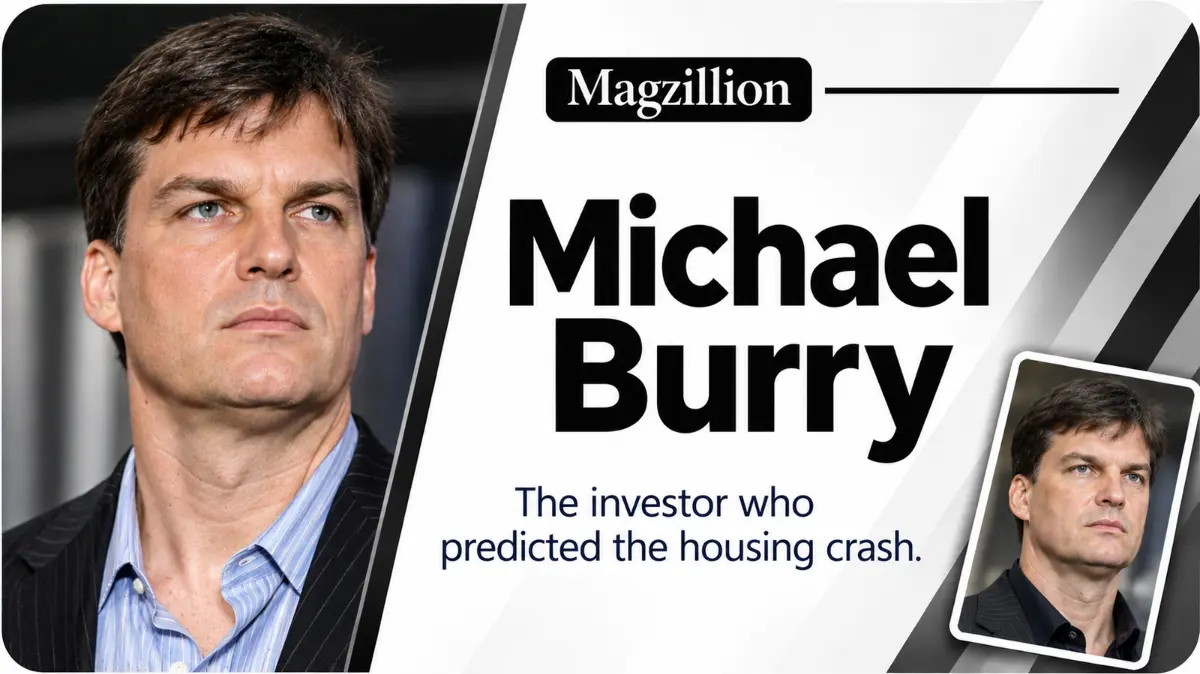
Michael Burry Net Worth: The Big Short Fortune, Scion Closure, and the Substack Era
Quick Facts
- Estimated Net Worth: About $300 million (published estimates range from $200 million to $350 million, and he has never confirmed a figure)
- Age: 55 (born June 19, 1971)
- Birthplace: San Jose, California
- Profession: Investor, physician, and former hedge fund manager
- Best Known For: Betting against the subprime mortgage market before the 2008 crash
- Current Venture: Cassandra Unchained, a paid investing newsletter on Substack
What Is Michael Burry’s Net Worth?
Michael Burry’s net worth is most commonly estimated at $300 million, the figure used by Celebrity Net Worth and repeated by many other outlets. The published range runs from about $200 million to $350 million, and Wikipedia’s profile cites $200 million to $300 million. Burry has never confirmed his wealth, does not publish personal financial disclosures, and does not appear on the Forbes or Bloomberg wealth rankings, so every figure is an estimate.
Most of that fortune traces back to one trade. Burry bought protection against subprime mortgage bonds before the housing market collapsed, and the bet earned him about $100 million personally and more than $700 million for his investors. Since then, he has built on that reputation with a relaunched hedge fund, a profitable GameStop investment, and, since late 2025, a newsletter with a large paying audience.
His situation looks different today than it did a few years ago. Burry closed his hedge fund in 2025, so his wealth now depends on his own investments and what he earns from writing. Both are hard to measure from the outside, which is why the number you see depends on where you look.
Why Michael Burry’s Net Worth Estimates Vary So Widely
Search for his net worth and you will find figures from a few million dollars to billions. Pages at the extremes rarely document where their numbers come from. Several factors explain the spread:
- No public disclosure. Burry is a private individual. Unlike a public company executive, he does not file reports that show his personal assets.
- Fund assets are not personal wealth. Scion Asset Management reported about $155 million in assets across four accounts in its most recent filing, but that money belonged to clients and his own capital, not to Burry alone.
- Volatile positions. His portfolio has leaned heavily on options and short positions, which can swing in value quickly.
- New income that is hard to value. His newsletter earns subscription revenue, and the number of paying subscribers has not been published.
- Old figures that never expire. Many sites copy a number from years ago and never update it.
The best way to read the $300 million figure is as a reasonable midpoint of a credible range, not a verified total.
Early Life and Education
Michael James Burry was born on June 19, 1971, and grew up in San Jose, California. He studied economics and premed at the University of California, Los Angeles, then earned his medical degree from Vanderbilt University School of Medicine.
From Medicine to Investing
After medical school, Burry began a neurology residency at Stanford University Medical Center but did not complete it. Instead, he left medicine to invest full time. The decision was unusual for a trained physician, and it set the tone for a career built on independent research and contrarian views. In November 2000, he founded his own fund, Scion Capital.
Start of His Investment Career
Early Value Investing Success During the Dot Com Era
Burry launched Scion Capital as the dot-com bubble was deflating. Celebrity Net Worth reports that the fund returned 55 percent after launch, which it credits to bets against tech stocks ahead of the internet bubble’s collapse. By mid 2005, Scion was up 242 percent, and by the end of 2004 it was managing more than $600 million.
Founding Scion Capital
Scion Capital started with money from an inheritance and loans from Burry’s family, according to Wikipedia. The fund’s early results made it attractive to outside investors, and that growing pool of capital gave Burry the room to place the larger and more unconventional bets that followed. Between its inception on November 1, 2000, and June 2008, Scion Capital recorded net returns of 489.34 percent after fees and expenses.
The Subprime Mortgage Bet and “The Big Short”
Burry’s reputation rests on what he did starting in 2005. Studying mortgage lending practices from the prior two years, he concluded that subprime mortgages, especially those with low teaser rates, would start losing value when the rates reset higher. He believed the housing bubble would collapse as early as 2007.
1. How Much Burry Made
Scion began buying credit default swaps on subprime mortgage bonds in 2005. By October of that year, Burry had told investors the fund held at least $1 billion in swaps. When the market collapsed, the trade paid off. Burry made a personal profit of about $100 million, while Scion earned more than $700 million for its remaining investors. Burry closed Scion Capital in 2008, after the trade had played out.
2. The Investor Revolt
The path to that payoff was not smooth. The housing market did not turn as quickly as Burry expected, and Scion had to keep making payments on its swaps while waiting. Some investors lost confidence and demanded their money back. Burry’s analysis was proved right by mid 2007, when the subprime market started to fail, but the episode shows how much risk he carried while being early.
3. How Short Selling Works
A short position is a bet that an asset will fall in value. In a traditional short sale, an investor borrows shares, sells them, and hopes to buy them back later at a lower price. If the price rises instead, losses can grow without a limit. A credit default swap works more like insurance. The buyer pays regular premiums and collects a large payout if the underlying bonds fail. Put options give the holder the right to sell a stock at a set price. Each of these tools lets an investor profit from a decline, but each also costs money to hold while waiting, which is what made the 2005 to 2007 period so difficult for Burry.
Scion Asset Management
The 2013 Relaunch
Burry reopened his fund in 2013 as Scion Asset Management, with a stated focus on his own investments, including water, farmland, and gold. The fund stayed small and concentrated, and its quarterly 13F filings, which list holdings, became closely watched by investors looking for hints of where Burry saw risk.
The GameStop Investment
- Scion disclosed a stake of about 5.3 percent in GameStop in April 2020, and Burry publicly urged the company to buy back its shares.
- Scion sold its entire stake in the fourth quarter of 2020, when the stock traded between roughly $10 and $20 per share, for a profit of around $100 million to the fund.
- The timing cost him. Only weeks later, GameStop became a meme stock, and Wikipedia reports the stake would have been worth over $1.5 billion at the peak.
- Burry said he had sold before the dramatic rise.
- As of January 2026, he said he was buying GameStop shares again, though not as a bet on a return of meme stock mania.
- His other public calls from this period had mixed results. He disclosed a bet against Tesla in late 2020 and warned about bubbles in bitcoin and other hot sectors.
- Not every call worked out, which is part of why estimates of his wealth stay modest compared with how famous his name is.
Why Burry Closed Scion in 2025
In late 2025, Burry shut down the fund. Scion’s SEC registration was terminated in November 2025, and reports said Scion was managing about $155 million for four accounts at the time of its most recent filing. Burry wrote that running other people’s money had limited what he could say publicly, and that he wanted to speak more freely. On November 13, he posted that he was moving on to “much better things.” Within days, he launched his newsletter.
The AI Bet Against Nvidia and Palantir
Shortly before closing the fund, Burry made headlines with a bet against two of the biggest names in artificial intelligence. Scion’s third quarter 2025 filing, released in early November, showed put options covering about 5 million Palantir shares and about 1 million Nvidia shares. The notional value was $912 million on Palantir and $187 million on Nvidia, for a combined total of roughly $1.1 billion. Those two positions made up about 80 percent of the fund’s reported portfolio value.
Burry returned to the social platform X in late October 2025 after a two-year absence, and he compared Nvidia’s role in the AI boom to Cisco’s role during the dot-com bubble. Nvidia responded with a memo rebutting accounting claims, which Burry called disappointing and said addressed arguments he never made. Palantir’s chief executive, Alex Karp, publicly dismissed the bet as illogical given the company’s growth.
What the “$1 Billion” Figure Really Means
The $1.1 billion headline number is easy to misread. It is the notional value of the shares the options cover, not the money Burry put at risk. A filing of this type does not reveal the strike prices, expiration dates, or the premiums paid. Burry said the actual cost was roughly $10 million per position, and other reporting put the Palantir premium near $9 million, which is about 1 percent of the headline figure. The positions also reflect September 30, 2025, so it is not clear how long Scion held them. Since Scion no longer files these reports, there is no public way to check whether he still holds the bets.
Cassandra Unchained: How Burry Earns From His Newsletter
On November 23, 2025, Burry launched a paid Substack newsletter called Cassandra Unchained. The name refers to the mythological prophet who told the truth and was not believed, and Warren Buffett had earlier given Burry the nickname Cassandra. Burry described the newsletter as his sole focus, and he said it frees him from the limits of managing client money.
The newsletter gives him a way to earn money from his analysis without managing outside capital, filing quarterly holdings reports, or answering to investors. Its paid tiers cost $39 a month or $379 a year, and a free option is also available.
Subscriber Growth Since Launch
According to Moneywise, Burry announced in mid 2026 that Cassandra Unchained had passed 300,000 subscribers just 231 days after launch, and it ranked second on Substack’s bestseller list at the time. That total likely includes free subscribers, and the number of paying subscribers has not been published, so the newsletter’s actual revenue cannot be calculated. Still, it is a meaningful new income source for someone who no longer runs a fund, and it helps explain why some estimates of his current wealth stay near or above $300 million.
In Popular Culture
Christian Bale’s Portrayal in The Big Short
Burry became famous beyond Wall Street through Michael Lewis’s book The Big Short and the 2015 film of the same name, in which Christian Bale played him. The film showed him as an eccentric, intensely focused fund manager who made his bet while most of the industry ignored the warning signs. The portrayal turned him into a household name and gave his later market calls far more attention than a typical fund manager would receive.
Real Estate
Burry keeps his personal life private, and little detail has been published about his property holdings. Reports have long placed him in Saratoga, California, where he lives with his family. Beyond that, the public record offers few specifics on the homes he owns or what he paid for them. Wikipedia describes Scion’s focus as including personal investments in land, such as farmland, along with water and gold, but values for these holdings have not been disclosed.
Personal Life
Burry is married and has children. He has said that his son was diagnosed with Asperger syndrome and that, after reading about the condition, he believes he may have it himself. He has spoken about how his focus on data and his comfort with working alone shaped his approach to investing. Beyond those details, he has kept his family life out of the spotlight.
FAQs
What is Michael Burry’s net worth in 2026?
Michael Burry’s net worth is most often estimated at about $300 million, with published figures ranging from $200 million to $350 million. He has never confirmed his wealth, and he does not appear on the Forbes or Bloomberg rankings, so the figure should be treated as an estimate.
Does Michael Burry still run a hedge fund?
No. Burry closed Scion Asset Management in 2025, and the firm’s SEC registration was terminated in November of that year. He now focuses on his paid Substack newsletter, Cassandra Unchained, which he launched on November 23, 2025.
How much did Michael Burry make from The Big Short trade?
Burry earned a personal profit of about $100 million from his bet against subprime mortgages, and the trade earned more than $700 million for his investors. Scion Capital recorded net returns of 489.34 percent between November 2000 and June 2008.
Is Michael Burry shorting Nvidia and Palantir?
Scion’s third quarter 2025 filing showed put options on Nvidia with a notional value of $187 million and on Palantir with a notional value of $912 million. The cost was far lower, roughly $9 million to $10 million per position, according to reports. Because Scion has closed and no longer files holdings reports, his current positions cannot be verified.
Does Michael Burry own Bitcoin?
There is no public report that he owns cryptocurrency. He called Bitcoin a speculative bubble in 2021, though he said he was not against it and thought it was overvalued and poorly understood. Datawallet reports that he later called it the “tulip bulb of our time” in a podcast appearance with Michael Lewis in December 2025.